Rewilding and Food Production—We Need Both.
We can’t rewild former agricultural landscapes and not consider where our food is going to come from. If we instead look to rewild within our agricultural landscapes, we might be surprised at how much biodiversity and food production can co-exist.
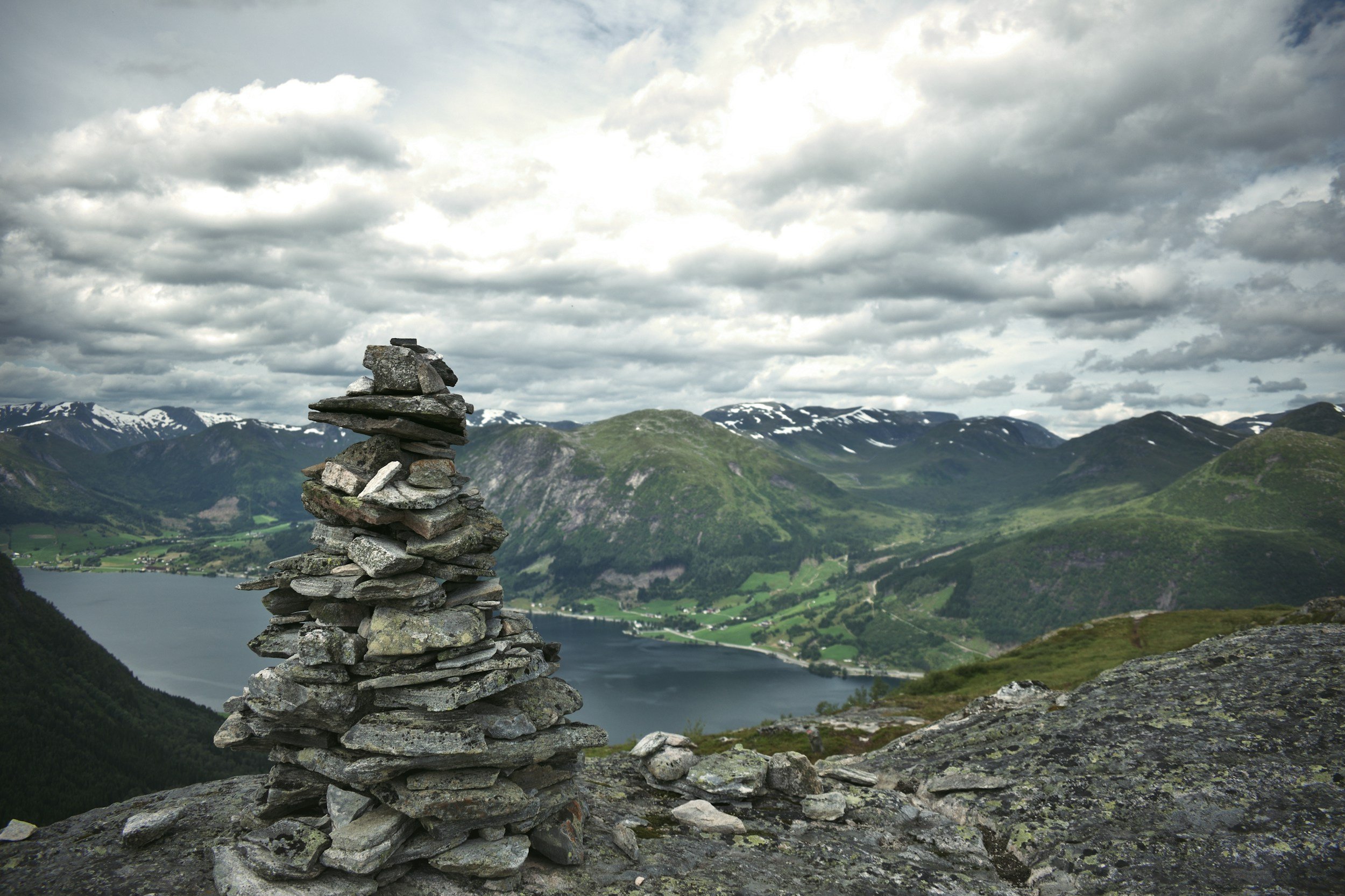
In the last few years, my imagination has been captured by stories of rewilding around the world. There is the story of the Oostvaardensplassen in the Netherlands, a huge rewilding project (over 13,000 acres) in one of the world’s most densely populated countries. This strategy was originally deployed for flood relief, but through the reintroduction of large native herbivores, the reserve has seen the return of native and rare bird species and other wildlife.
There is also Isabella Tree’s beautiful book Wilding which describes the 3500-acre historic Knepp Estate, originally a hunting park for English royalty and most recently, an operational dairy farm that was intentionally returned to nature over the last 20 years.
A Must Read for any aspiring nature-minded farmer, or regenerative agriculture-minded consumer
In their efforts to give nature space to regenerate, they have seen a return of native bird species, including the imperiled turtle dove, regrowth of oak trees that require an open canopy to thrive, and clear signs that biodiversity can return even where it had been completely suppressed. One of the biggest reasons for the turtle dove’s decline—removal of 100,000 miles of hedge rows across England in the name of maximizing food production since 1950. These thorny hedge rows provided safe nesting habitat and their primary food source during the nesting season. It wasn’t removal of a single pristine “wild” habitat—it was the removal of hundreds of thousands of micro habitats across Britain’s farms.
Everyone in the US seems to know the story of returning wolves to Yellowstone National Park and how that single species reintroduction dramatically reshaped forests and rivers for the better (the beavers’ return also played a significant, although less well known, role). These stories highlight how resilient nature is—how quickly it can return if we give it the space and even better, a gentle push.
These are just a few of the many examples of “rewilding” taking hold across the world, and they give me hope that we haven’t yet tipped past the point of no return ecologically.
At the same time, we need to consider the effect of “leakage”, which refers to the concept that we might “rewild” or restore certain regions, particularly in abandoned or degraded farmland, only to shift the destruction of nature elsewhere in the world to replace the production of food or other goods. As an example, we remove cows from landscapes in the US so that waterways and forests can recover, but then import beef that was fed soy grown in deforested regions of the Amazon.
Leakage is incredibly hard to trace and establish causality, but it is an unavoidable reality of the global supply chain. This inevitable connection between nature and food/fiber production is one we ignore at our own peril. As populations become increasingly city-centric, leaving rural areas less populated and typically producing less food, it makes sense that farmland will be abandoned on the fringes and nature can reestablish. But we can’t just trust that it is on balance a good thing—we need to also think about where our food comes from and make sure that we are building resilient food supply chains in areas that are already disturbed—and shifting that production to systems that co-exist with nature.
If we rewild the northern hemisphere because we import much of our food from elsewhere, but plunder tropical regions and the southern hemisphere to grow that food, we lose the fight on climate change, on global biodiversity loss, and on social progress for many regions. We are all responsible for not just what we grow and produce in our own country, but what we consume. We cannot rewild our backyard in the name of sustainability and then source products from other parts of the world that are destroying biodiversity.
While we obviously cannot know what is happening in every country or dictate global sourcing, we can focus on building self-sustaining ecosystems and resilient food supply chains in our own “backyard”. At Land Steward Partners, we aren’t trying to eliminate food production in the name of conservation. We are working with land stewards who produce better food while also restoring nature. The fact that this is not only possible, but more economically profitable is incredibly exciting. Bison are the epitome of this thesis—we can restore overgrazed and degraded landscapes through regenerative rotational grazing, while producing one of the healthiest protein sources on the planet. We can produce nutrient dense food and provide habitats for migrating waterfowl. We can provide livelihoods for rural ranchers and store carbon in soils.
Bison at Roam Ranch in Fredricksburg, TX (an Audubon Certified Bird-Friendly Ranch)
Making Fast Friends in the Regenerative Farming Community
Part of why I love learning about farmers who are growing food in harmony with nature—instead of working against it, is learning about their “why”. Will’s “why” does not disappoint. He likes finding ways to add and build to the family business, but doing it in a way that does not require “killing stuff”, like insects and plants. He enjoys growing food that people eat. He knows where most of his crops end up and takes immense pride in that. He is also driven by the fact that his farm does not negatively impact anyone downstream—from chemical, fertilizers, or anything else. It’s “clean production.” For me, it’s all of the other parts of Will’s strategy too—the fact that Will’s farm has higher insect diversity, greater bird species abundance and diversity, small check dams that slow down water and create seasonal habitat, and stream protection from overgrazing. Will’s farm shows that it is possible to grow food, be profitable, and steward the environment. We can help direct investment to enable more farms to follow this model.
Finding Common Ground from the City to the Farm
Seeking Out Farmers to Understand Farming
Seems obvious that if you want to understand farming, you would go talk to a farmer. But as someone who lives in downtown Chicago, grew up in the suburbs of St. Louis, and rarely crossed paths with farmers in my day-to-day life, finding this opportunity in 2018 for me was more elusive than you might imagine.
As uncomfortable as it can be to go to an event where I know no one, I often have to go anyway in the career I have chosen. Luckily, I have found that when I am willing to be vulnerable and venture outside of my comfort zone, I almost always meet people that end up sparking creativity and incredible partnerships. On a cold Chicago day in March 2018, I met my friend Will for the first time at the Good Food Expo. It was a Friday and I had taken the day off work to attend the event, since it had little relevance to my actual job at the time and I thought my boss might laugh if I asked to go on company time/dime. My day job was working for a renewable energy developer, supporting the environmental permitting for utility scale wind and solar projects in the Great Plains and Western US. I spent most of my days reviewing biological reports about birds, big game, and wetlands that existed in the potential or operational wind and solar projects and meeting with state and federal wilding permitting agencies. My company used this information to determine setbacks and other strategies to minimize impacts to those natural resources from the construction and operation of an energy project. What did this have to do with the Good Food Expo? Well, nothing, if you asked my employer. But for me, I saw the connection—almost all of these energy projects were built on farms and ranches.
As I reviewed report after report on these rural farms, I couldn’t help noticing that there seemed to be a lot of wildlife in these places.[1] I also came to appreciate that farms and ranches make up most of the land use in the US (~880M-1B acres or ~30-40% of land in the US). This conflicted with preexisting narratives in my head—1. that “real” wildlife lives only in “wild places” and 2. farms were dead zones devoid of wildlife habitat. I had read articles and books describing modern farms as a major source of carbon emissions, degraded water quality, topsoil erosion, and loss of habitat. How did this equate with what I was seeing in these reports? I needed to square these two realities in my head, which led to more reading—about the history of farming in the US, regenerative agriculture, and ultimately, seeking out opportunities to talk to farmers in real life…at the Good Food Expo.
I couldn’t remember the exact setting, but Will remembered we met at the end of day happy hour. He grabbed a beer and I sat down at his table like a creep to ask annoying questions of a stranger! When he asked what brought me to this event, I shyly admitted that I was interested in regenerative agriculture—knowing I was way out of my depth. If anyone there wanted to call me out for attending a conference about something I knew very little about, they would have been totally reasonable to do so. But lucky for me, that’s not really the vibe of the regenerative agriculture community. Instead, Will was thrilled to hear that I was interested and believed in regenerative agriculture. He was eager to tell me about his farm, his recent investment in an organic spirits distillery, and his practical experience managing a regenerative organic farm. It was the beginning of a friendship that’s going on ten years, fueled by our shared curiosity about how to bring more of this positive land stewardship to reality.
A Leader in Regenerative Organic Farming at Scale
Will is a farmer from Paxton, Illinois, a small town in Ford County—about 110 miles from downtown Chicago. Will’s family owns 480 acres, all of which is organic and utilizes the classic regenerative cropping practices (i.e., diverse crop rotation, cover cropping, integration of animals to build soil fertility, and no-till) and then some.
The farm wasn’t always certified organic—the official conversion happened in the early 2000s, under the management of Will’s parents (more here about Will’s parents). But the farm had always stayed close to the regenerative practices that used to be standard farming practice, before the “green revolution”. His grandfather and uncle utilized mostly organic practices to grow corn, oats, and hay, but began to supplement with the use of pesticides, herbicides, and fertilizers when these chemical additives were introduced in the 50s. Luckily for Will’s family farm, however, these foundational practices were never abandoned, and when the National Organic Program finalized organic regulations in 2000, Will’s family saw an opportunity which aligned with their personal dislike for using chemicals on their farm. Will’s parents bought an 80-acre field to connect two separate parcels of family land that had been separated by a conventional farm and co-founded the Midwest Organic Famers Co-op. The Glaziks saw an opportunity to build on what they were already doing and access a value-added organic market.
Will’s personal story is particularly compelling not only because he is the second generation of a profitable regenerative organic farm, but also because he has continued to diversify his farm through value added products and is actively sharing his learnings so that others can benefit from his experience.
Will and his brother farm 800 acres together, 480 acres of which he rents from his parents, and the rest is rented from other landowners. His favorite crop to grow is corn—as he describes it, the most beautiful crop there is. But a regenerative farm requires a diverse crop rotation, which means he also grows soybeans, wheat, oats and rye.
Photo: Corn ready for harvest on Will’s farm.
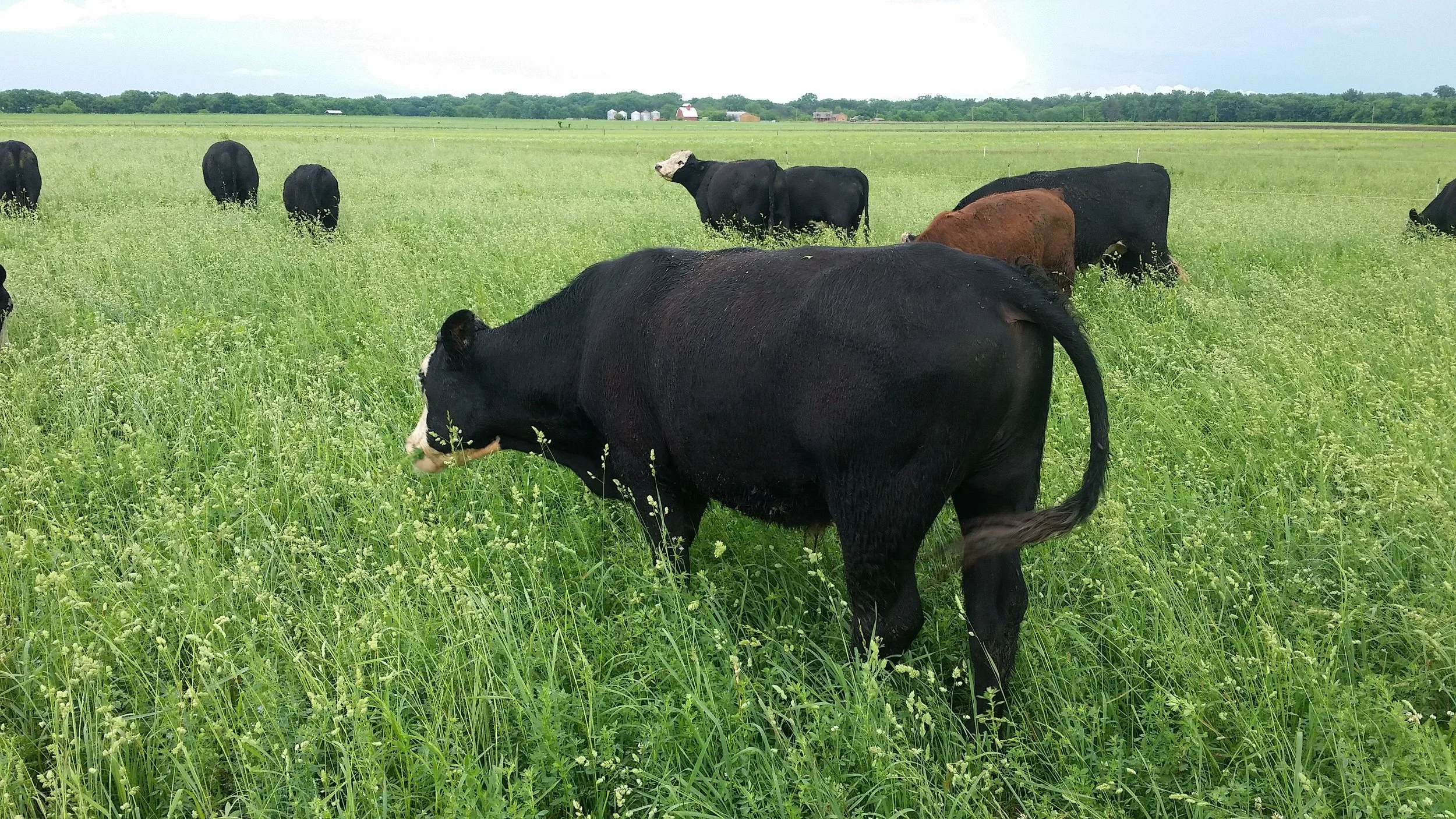
Will partners with a neighbor to lease some of his land to grow row crops, and as part of their partnership, his neighbor runs his cows through Will’s farm to graze on crop residue and cover crops. Will’s dad also rotates his herd through some of the fields, providing natural fertility and building soil organic matter the old-fashioned way (and practically free for Will). This reduces or eliminates the need for artificial inputs like chemical fertilizer. Will’s wife is a veterinarian, which is an amazing skillset to have around a farm with livestock!
Photo: Cows play their role fertilizing the land on Cow Creek Organics and providing meat for the family.
On top of these traditional crops, Will worked with NRCS to plant a mix of perennial trees and shrubs in his organic buffer. Every organic farmer needs a 25-foot edge-of-field buffer to account for drift spray from conventional neighbors. In this buffer, Will must follow organic practices, but he cannot sell these crops as “organic” in case they have residual chemicals from his neighbors’ farming operation. Many farmers just plant corn or beans in this acreage and sell it for the commodity market price—if it grows under these suboptimal conditions, maybe even losing money. But for Will, this presented another opportunity for diversification. He planted a variety of species in his buffer (hybrid poplars, white oaks, willows, hickory, and aronia berries). The perennial tree buffer helps slow down water as it drains from Will’s fields, provides habitat for wildlife, and filters any excess nutrients that might run off the fields. Financially, as a worst-case scenario, Will has created a wind break, a new high value crop (aronia berries), and a timber harvest in the future. Best case scenario, he has all that and he can use the white oaks for an “estate label” for his other business, Silver Tree Beer & Spirits.
Building in a Captive Buyer & Higher Margin Products
In 2017, Will co-founded the distillery with his siblings in Paxton, which sells whiskey, vodka, and gin made from organic regenerative grains grown by his brother Dallas and him. His other brother Clayton manages the taproom, and his sister Abby manages events and marketing.
Photo: Barrels of Silver Tree product in the Distillery in Paxton, IL.
By creating the distillery, the family has developed a built-in end user for its grain, with additional revenue to be made from selling the spirits and beer. I was fortunate to attend a dinner hosted at Silver Tree and the Land Connection in October, and to spend the day trying my hand at bottling whiskey. For my Chicago friends, you can pick up some Silver Tree at Binny’s. Sorry in advance if you get a bottle with a lopsided label…
Photo: Bottling whiskey at Silver Tree.
It’s Not Scalable, but it’s Highly Replicable
On top of farming and the distillery, Will is a regional markets consultant for the Rodale Institute, an agricultural research and education nonprofit that furthers the growth of organic regenerative agriculture across the US. One of Will’s responsibilities in this role is hosting and facilitating events to educate farmers on new perennial cropping strategies, like those he has employed on his own farm.
Photo: Will leading a farm visit at Cow Creek Organics.
After the conference in March 2018, I visited Will’s farm that fall and brought along some other friends that owned a family farm in the Driftless and were interested in organic farming. Will later helped them transition 230 acres to organic in partnership with local farmers. This is just one example of Will sharing his expertise with others to enable more organic regenerative farming.
Photo: a bin of the 2018 Bloody Butcher corn harvest during our farm visit.
Will gets his best ideas while he’s driving his tractor. He is constantly looking for new ways to build more diversity and resilience into his operation. But he is not looking to “scale”, in terms of acres farmed or even the distillery. He does not want to become the largest distributor of organic regenerative whiskey and vodka, or to add another 2000 acres to his farming. He does have an interest in teaching other farmers, however, so that his methods can be replicated. To borrow a saying from Will Harris of White Oak Pastures in Bluffton, Georgia, “it’s not scalable like industrial farming, but it’s highly replicable.” As we think about all that is wrong with our current system, the relentless focus on scale and growth for growth’s sake is part of the problem. Scale and growth inevitably require capital, which requires investors, which requires meeting investor expectation, which can result in perverse incentives to take actions for short-term benefit but less resiliency long-term. The focus on scale takes us away from regional foodsheds in a relentless pursuit of growth. There is a point at which the operation becomes too big for one person to manage alone, requiring employees and ultimately would require Will to spend his days differently. That isn’t for everyone. Will has been strategic in growing his business in a way that still lets him do the work he loves—growing corn.
If this can work, why isn’t there more of it?
I like to call Will every time I have an investment idea about farming or environmental restoration in partnership with farmers. He is usually adept at nicely pointing out the holes in my strategy, or how I should think differently about the idea to consider a nuance that only an actual farmer would understand. He understands my obsession –if regenerative farming is so much better for soil health and biodiversity, and we know how to do it—why aren’t we doing more of it? What are the barriers to scaling this approach and how do we solve for them? The truth is that there are many barriers, and they are complex.
Lately we have been discussing what Will would do with $5M. If like-minded investment capital was available, how would Will put it to use? He has many ideas, ranging from alternative uses for distilling byproducts and buying a local organic mill to close a gap in the regional grain supply chain. In Will’s opinion, it’s the regional distribution and infrastructure that is lacking, particularly for organic farmers. The supply side is not the problem—we are more than capable of growing plenty of food and even growing it without chemicals. It’s getting it to the market in a way that still results in sufficient margin for the farmer. When organic farms are sparsely distributed across rural landscapes, it’s harder to aggregate inputs and offtake (for example, getting regional grain processing for organic grain is expensive and the mills are few and far between).
The Possibility of Scaling Regenerative Organic Farming
Part of why I love learning about farmers who are growing food in harmony with nature—instead of working against it, is learning about their “why”. Will’s “why” does not disappoint. He likes finding ways to add and build to the family business, but doing it in a way that does not require “killing stuff”, like insects and plants. He enjoys growing food that people eat. He knows where most of his crops end up and takes immense pride in that. He is also driven by the fact that his farm does not negatively impact anyone downstream—from chemical, fertilizers, or anything else. It’s “clean production.” For me, it’s all of the other parts of Will’s strategy too—the fact that Will’s farm has higher insect diversity, greater bird species abundance and diversity, small check dams that slow down water and create seasonal habitat, and stream protection from overgrazing. Will’s farm shows that it is possible to grow food, be profitable, and steward the environment. We can help direct investment to enable more farms to follow this model.
In comparing our memories about our initial meeting, Will and I realized that the only time either one of us has attended the Good Food Expo was in 2018. A chance encounter that resulted in a partnership for 230 new acres of organic farmland in Illinois and ten years of friendship and brainstorming investment ideas that can further the growth of regenerative agriculture and better land stewardship. A little inspiration to continue to push ourselves outside of our comfort zones to further the outcomes we believe in deeply.
Photo: Nat (friend of the farm!), Will, and me at the 2025 Land Connection Dinner in Paxton, IL at Silver Tree Beer & Spirits.
Relishing the Quiet Work of January
In January, we get back to work, and I feel like it’s just what I need after several weeks of chaos and indulgence.
It’s time to quietly build, put in the hard work, and focus on personal wellness and health too. Just like plants and animals go into a dormant period where they are hibernating and conserving energy in the winter, we can go into a period of deep work and focus for a few months, cutting back on the extra activities that drain our energy.
There’s something to love about January. We’re all coming down from a few weeks (or months) of extra busyness. We’ve been making magic for others and probably merrymaking ourselves. Maybe indulging a bit more than normal, sleeping in, and leaning into lazy movie days here and there. Instead of building project models and scheduling Teams calls, I’ve been building multi-course meals and scheduling back-to-back plans for the whole family. In my house, the kids are out of school, so any expectation of traditional productivity has gone way down the last few weeks. As much as we spend all year trying not to admit it, we need this break from routine—if only for a little while. Our brains need to unplug from the cortisol drip and we need to do nothing productive for a minute. In some way, these weeks are what we work all year for—time with family and friends, travel and late nights—a little break for fun.
But in January, we all step back into our routines—often begrudgingly. Our hearts think we want the break to go on indefinitely, but our minds actually crave routine and structure. In January, we get that back and for at least a while, it feels so good. At the same time, it’s still winter. It’s still bitterly cold in Chicago for a few more months. It’s a chance for routine and slowness at the same time. Compared to November and December which is routine and packed schedules, I am relishing this new normal. It’s time to quietly build, put in the hard work, and focus on personal wellness and health too. Just like plants and animals go into a dormant period where they are hibernating and conserving energy in the winter, we can go into a period of deep work and focus for a few months, cutting back on the extra activities that drain our energy.
We’re at the very beginning of this LSP journey, and yet the work we are doing has been underway for many years. We are building on the foundation laid by so many visionaries and farmers and committed creative individuals that are convinced that there is a better way to grow food and care for our environment. I am filled with excitement and joy that this is the work I get to do. I’m looking forward to all of the conversations, spreadsheets, projects, and partners we will encounter and develop in 2026. Let’s get to work.