
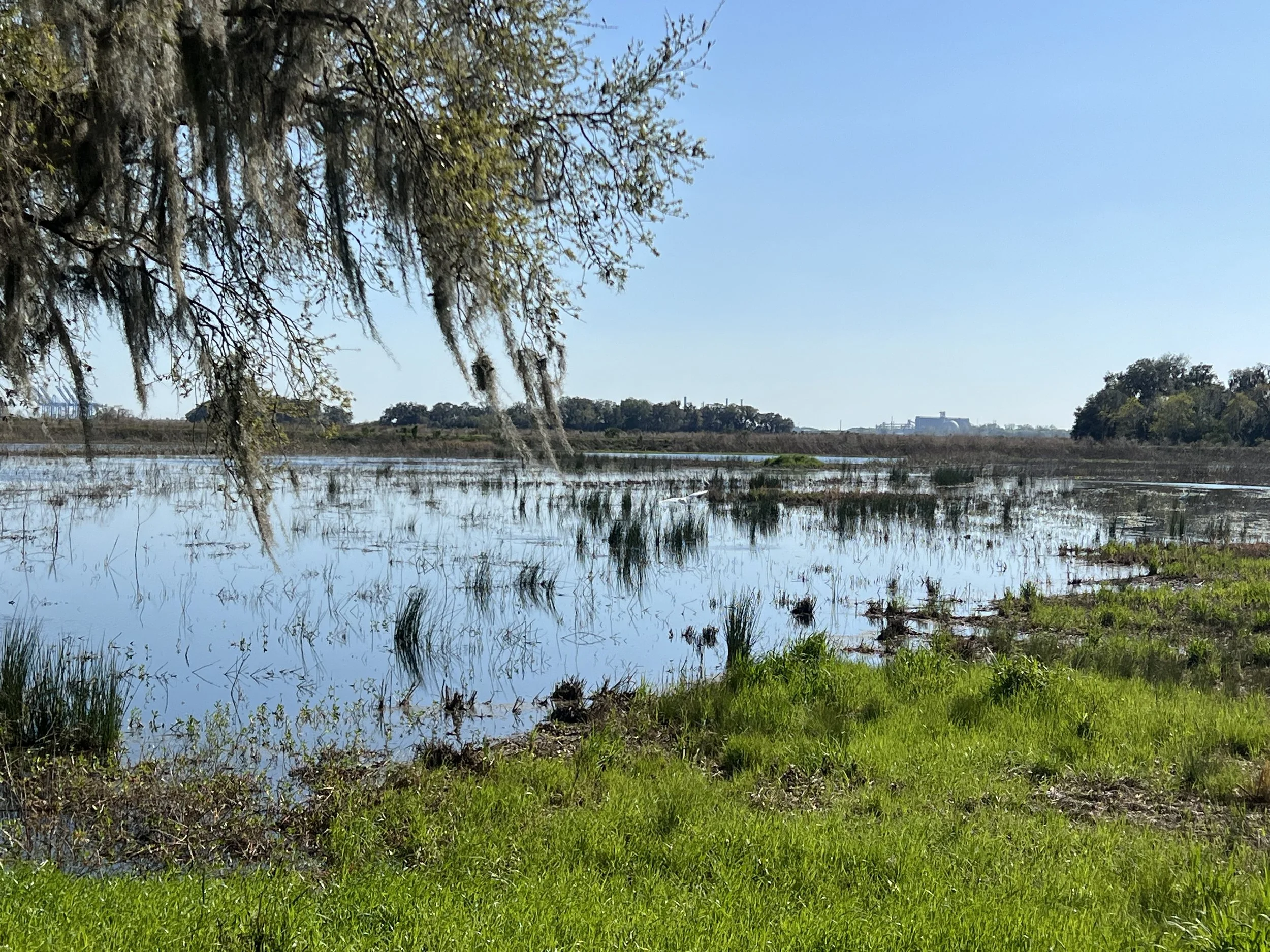
Some fields aren’t meant to grow crops.
What If We Paid Farmers to Do What's Best for the Land?
Rethinking the Farm Bill, agricultural subsidies, and the economics of nature.
I've spent much of the past year thinking about how to make nature investable. How do we create markets for biodiversity? How do we get companies to pay for cleaner water? How do we attract private investment into restoring grasslands, wetlands, and other natural systems?
But a recent conversation with University of Illinois agricultural economist Bruce Sherrick raised a more fundamental question.
Does it matter if we create a biodiversity credit for working lands if we're simultaneously spending vastly more money supporting economic activities that can degrade it?
He’s got a point. We spend a lot of time discussing the nature finance gap: the enormous difference between what we currently invest in nature and what we need to invest to reverse biodiversity loss and ecosystem degradation.
Most proposed solutions focus on finding new money. More biodiversity credits. More watershed markets. More corporate investment in nature. More conservation philanthropy.
I'm working to develop some of those markets myself. I believe they have an important role to play. But perhaps we should spend just as much time examining the money we're already spending—and asking whether we could accomplish more with it. American agricultural policy is the obvious place to start.
The strange economics of growing corn
Consider the economics of a typical cornfield in central Illinois.
The farmer plants in the spring, applies fertilizer and other inputs, manages the crop through the growing season, and harvests in the fall. Depending on the year, that farmer might produce more than 200 bushels of corn per acre.
American agriculture has become extraordinarily productive. But productivity and profitability are not the same thing.
According to the University of Illinois' 2026 crop budgets, projected returns for corn on cash-rented farmland in central Illinois can be negative after accounting for production expenses and rent. That means a farmer can produce an enormous amount of corn and still lose money growing it.
Now consider the financial relationships behind that acre. The farmer pays for seed, fertilizer, chemicals, machinery, fuel, labor, and land rent. The farmer bears substantial production and market risk. And in many cases, the farmer doesn't own the land. The landowner, meanwhile, receives an agreed-upon cash rent regardless of whether the crop makes money that year, assuming the tenant can meet the obligation. And the tenant is directly incentivized to pay the landowner because if they don’t, they lose access to those acres forever.
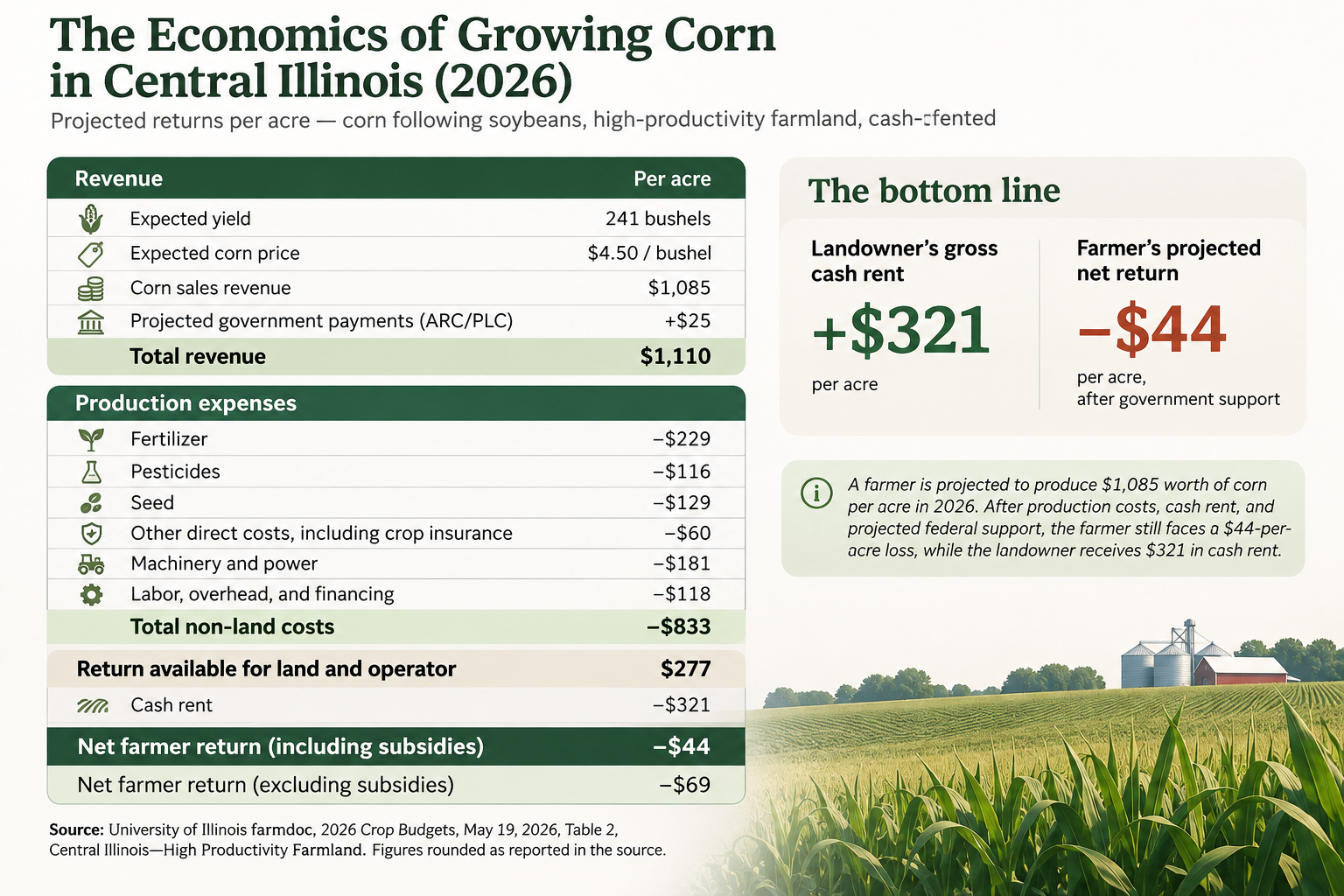
Source: University of Illinois farmdoc, 2026 Crop Budgets, May 19, 2026, Table 2, Central Illinois—High Productivity Farmland. Figures rounded as reported in the source.
On high-productivity farmland in central Illinois, a farmer is projected to produce $1,085 worth of corn per acre in 2026. After production costs, cash rent, and projected federal commodity payments, the farmer still faces a $44-per-acre loss. Meanwhile, the landowner receives $321 in contractual gross cash rent per acre. These are projected economic returns, not actual farm-level results.
The farmer continues renting and planting the land even during unprofitable years. And federal agricultural programs help cushion some of the financial risk of remaining in production. Commodity support programs provide payments when specified price or revenue conditions are met. Federally subsidized crop insurance helps protect against yield and revenue losses.
To be clear, farmers generally do not have to plant corn or soybeans to receive Agriculture Risk Coverage or Price Loss Coverage payments. Those programs are largely tied to historical base acres. And not every farmer receives payments or loses money growing commodities.
But taken together, the economics of land rent, existing equipment, commodity markets, and government risk protection can make continuing to farm the rational decision for an individual farmer, even when the financial returns are break-even, or potentially negative.
But is it the most economically rational use of our public dollars?
What if we used those same dollars to give farmers more choices about how to manage their land—and rewarded them for producing not just agricultural commodities, but also clean water, healthy soils, and thriving ecosystems?
What are we actually subsidizing?
The United States has spent generations building an agricultural safety net designed to stabilize farm incomes, manage production risks, and support an abundant supply of agricultural commodities. And by many measures, it has succeeded.
We have an extraordinarily productive agricultural sector. American farmers supply domestic and international markets with food, feed, fuel, and fiber. There are legitimate reasons to maintain an agricultural safety net. Farmers face weather risks, volatile commodity markets, and economic conditions largely outside their control. Food security matters. So does keeping farms financially viable.
But the scale of public investment raises an important question about what we expect in return. According to the Congressional Research Service, the federal government is projected to spend approximately $143 billion on commodity programs and $156 billion on crop insurance over the 2027–2036 period. That's nearly $300 billion over ten years, before accounting for the separate conservation budget ($73B over ten years).
These are projected expenditures, not a fixed pool of annual subsidy checks. And they are not all environmentally harmful. Nevertheless, they represent an enormous public commitment to managing the financial risks of agricultural production.
Meanwhile, we're trying to create new markets where farmers can earn money for storing water, improving soil health, reducing nutrient runoff, and restoring wildlife habitat. Consider the contradiction.
We are trying to persuade private companies and municipalities to pay farmers to restore ecological functions, while our established agricultural support system pays them to plant as many acres as possible. What if we approached the problem differently?
What if we didn't need to spend more money on agricultural subsidies? What if we simply expanded the options of what farmers could get paid to do?
Imagine a Farm Bill with three paths
Rather than eliminating commodity subsidies or crop insurance, imagine redesigning the agricultural safety net to give farmers three legitimate pathways to financial security.
Path 1: Continue producing commodity crops
Farmers who want to grow corn, soybeans, wheat, and other commodities could continue doing so with the protections provided by existing agricultural support programs. The goal wouldn't be to dismantle conventional agriculture or force farmers into conservation.
Productive farmland would continue producing crops. Farmers would retain protection against major production and market risks, subject to existing conservation requirements.
Path 2: Transition to more regenerative agricultural systems
A farmer who wants to diversify crop rotations, reduce reliance on synthetic fertilizers and pesticides, integrate livestock, or establish perennial crops could receive additional financial support during the transition.
Changing farming practices can be economically risky. Adding small grains to a corn-soybean rotation may reduce short-term revenue. Establishing new forage systems requires investment. Reducing chemical inputs may require new equipment, knowledge, and management strategies.
Some of these changes can improve profitability over time. But the transition years can be financially difficult, particularly for farmers already operating on thin margins. The agricultural safety net can help absorb those transition risks, while enabling more long-term resilience for that farm.
Instead of asking farmers to take on the full financial burden of changing their operations, federal support could help cover establishment costs, temporary revenue reductions, technical assistance, and the risks associated with adopting new production systems. Farmers would still produce agricultural commodities. They would simply have more financial freedom to change how they produce them.
Path 3: Get paid to restore and steward land
Now consider the acres that perhaps shouldn't be growing annual commodity crops at all: fields that flood repeatedly, steep slopes that lose soil, sandy ground that struggles to produce profitable yields, and low-lying areas that were once wetlands.
What if farmers could earn a reliable income by restoring those acres? Instead of growing corn on a field that floods every few years, a farmer could restore a wetland and receive an annual stewardship payment. Instead of repeatedly planting an erosion-prone hillside, a farmer could establish perennial grassland and manage it through grazing.
Instead of cultivating every acre to the edge of a stream, a farmer could establish riparian habitat that filters runoff and protects water quality. These activities would become legitimate, publicly supported agricultural enterprises. And critically, a farmer wouldn't have to choose one pathway for the entire farm.
A 1,000-acre operation might continue producing commodities on 800 acres, adopt more diverse rotations on another 100, and restore wetlands or grasslands on the remaining 100.
The farmer could make decisions based on what made the most economic and ecological sense for each piece of land.
We actually already have this path for farmers through our conservation programs—but its underfunded. 2/3 of applications to utilize the conservation programs go unfunded. I’m suggesting we let farmers lead with how those funding buckets of funding are balanced. Instead of asking farmers to choose between financial security and better stewardship, let's use the agricultural support system to help them achieve both.
Give farmers choices, not mandates
I've argued before that we need to pay for ecological outcomes, not just conservation practices. And I still believe that, particularly when we're developing private markets for biodiversity and watershed stewardship.
But I think the answer depends on what we're trying to accomplish.
If a municipality is paying for cleaner water, it should have confidence that its investment is actually reducing pollution. If a company purchases biodiversity credits, those credits should represent measurable ecological improvements.
But if we're designing a national agricultural support system intended to serve millions of farmers, simplicity matters. We don't need to build a new elaborate nationwide system to measure and price every gallon of water stored, every ton of soil retained, or every bird returning to a restored grassland before we can begin supporting better land management.
We already know a great deal about which agricultural practices can improve soil health, reduce erosion, protect water quality, and support biodiversity. We could establish straightforward payments for eligible practices and land uses, tailored to regional conditions, while measuring environmental improvements at the watershed and landscape scale to make sure the program is delivering results. And we could build on the conservation programs USDA already administers rather than inventing an entirely new bureaucracy.
But there's another reason I favor this approach: political feasibility.
I am not arguing that we should eliminate agricultural subsidies or dismantle the farm safety net. In many ways, that safety net protects all of us. It helps stabilize the agricultural economy, manage risks that individual farmers cannot control, and maintain a reliable supply of food and other agricultural products.
Those are legitimate public benefits worth protecting. What I'm questioning is why our agricultural support system doesn't give farmers more economically viable choices about how to manage their land. Why should a farmer feel compelled to keep planting a field that floods every spring because they can't afford to lose the acreage? Why shouldn't they be able to restore that field to wetland, continue managing it, and receive comparable financial support for providing a different public benefit?
Why shouldn't a farmer who wants to diversify crop rotations or reduce chemical inputs receive financial support during the years when changing practices creates the greatest economic risk?
We don't need to force anyone to stop growing corn or soybeans. We don't need to tell farmers which acres to restore. And we don't need to eliminate the protections that conventional producers rely on. And we probably don’t need to spend more money than we already spend to see meaningful progress.
We need to give farmers more choices—and make those choices financially viable.
A farmer should be able to look at their land, decide what makes the most sense for its long-term productivity and health, and choose a management path that allows them to remain financially secure. Some acres will continue producing commodities. Others might transition to more diversified agricultural systems. And others could become wetlands, grasslands, or grazing lands.
The government's role wouldn't be to prescribe a single answer. It would be to create a financial framework in which those different choices are possible. This approach won't resolve every challenge in agricultural policy. But a voluntary system that preserves the existing safety net while expanding eligible activities may offer a more practical starting point than trying to redesign American agriculture through mandates.
The goal isn't to pay farmers less. It's to give them more ways to earn a living doing what's right for their land.
Farmers are already asking for more choices
And there's reason to believe farmers would take advantage of these opportunities.
Conservation programs are consistently oversubscribed. According to a 2026 analysis of USDA data by the Institute for Agriculture and Trade Policy, only 24% of applications to the Environmental Quality Incentives Program and 37% of applications to the Conservation Stewardship Program resulted in contracts in fiscal year 2025.
Farmers are already seeking financial assistance to improve soil health, manage water, diversify production, and adopt conservation practices. Existing programs aren't consistently able to meet that demand.
And some farmers are questioning the underlying economics of the commodity support system itself. In a 2020 interview, former Montana Senator and organic farmer Jon Tester argued that farmers would prefer to earn their living through functioning agricultural markets rather than depend on government checks.
Not everyone agrees on the solution. Many commodity producers understandably want stronger income protections, particularly when production costs are high and margins are thin.
But that's precisely why I think expanding farmer choice is worth exploring. We don't have to choose between supporting farmers and supporting conservation. We can preserve the essential agricultural safety net while creating more opportunities for farmers to earn income through stewardship. The demand is already there. The question is whether our agricultural policy will make room for it. At some point, as farms rebuild soil health and resilience, some farmers may not need the subsidies at all. But we should support them if they try to figure out how to make that transition.
But what about the landowner?
There's another important piece of this equation.
A substantial amount of American farmland is operated by farmers who rent rather than own it. And the economics of land ownership and farm operation are very different.
The farmer makes the annual management decisions and bears much of the operating risk. The landowner controls the long-term use of the property and receives rental income. If we want farmers to make long-term investments in soil health, wetlands, grasslands, and habitat, we have to recognize that many of them don't control the land long enough to capture the benefits.
And if new stewardship payments simply get absorbed into higher cash rents, we may end up transferring more public money to landowners without adequately compensating the farmers doing the work. Any redesigned support system would need to address this.
Long-term stewardship contracts might require landowner participation, secure lease terms, and clear agreements about how payments are shared. The objective should be to make restoration financially viable for the person managing the land while giving the landowner a reason to support long-term improvements.
This is particularly important if we want conservation to become a durable land-based business rather than a temporary activity dependent on grant funding.
Same dollars. More outcomes.
The obvious question is how we would pay for all this. My proposal is this: don’t eliminate conventional agricultural support and replace it with conservation payments. Instead, create parallel options within the existing agricultural support framework.
Farmers who continue producing commodities would retain access to a safety net. Farmers who transition their production systems would receive support for taking on new risks. And farmers who dedicate eligible acreage to ecological stewardship could receive reliable payments for doing so.
The total federal spending commitment could remain the same, with resources allocated among these pathways. That would require careful design. Commodity payments and crop insurance costs fluctuate, and a genuinely budget-neutral proposal would need to account for those obligations. Congress would also have to decide how to fund new options without simply adding them on top of every existing benefit.
But that's a question of program design, not a reason to dismiss the opportunity. And we wouldn't be starting from scratch. USDA already administers conservation contracts, agricultural insurance, commodity programs, and technical assistance. We have much of the institutional infrastructure necessary to support different land-management choices.
The opportunity is to make those choices more economically competitive. We should also be clear about the tradeoffs. Not every conservation practice is appropriate everywhere. Not every acre should be retired from production. And a redesigned safety net would need to protect farmers from catastrophic losses while avoiding unnecessary administrative complexity.
But imagine what could happen if even a portion of existing agricultural support helped make better stewardship financially viable across millions of acres. More diversified farms. More perennial grasslands. More wetlands storing water during major storms. Less soil washing into rivers. More habitat for birds, pollinators, and other wildlife.
And perhaps more resilient agricultural businesses.
What does this mean for nature finance?
I still believe we need private markets for biodiversity, watershed stewardship, and other ecological services. Municipalities facing expensive water treatment challenges should have opportunities to invest in upstream solutions. Companies that depend on healthy watersheds should have ways to support their restoration. Investors should be able to finance land-based businesses that generate both economic and ecological returns.
But these markets shouldn't have to overcome the entire financial disadvantage of conservation on their own. Public agricultural support could provide a foundation for stewardship, while private markets can direct investment into additional, geography-specific and measurable outcomes that buyers value.
That distinction matters. We would need safeguards against paying twice for the same benefit. But well-designed public and private financing could complement one another. Perhaps the greatest opportunity in nature finance isn't simply convincing more investors to care about biodiversity. Perhaps it's recognizing that we already have an enormous financial system shaping how American land is managed.
And we have an opportunity to ask more of it.
Rethinking what American agriculture produces
The purpose of agricultural policy has never been purely economic. We have long supported farmers because we recognize that agriculture produces things society needs, and because leaving the entire system exposed to market volatility carries real risks.
But what society needs from agricultural land is changing. We still need food, feed, fuel, and fiber. But the system is out of balance. We are producing more than enough of some things and not enough of other things. We also need clean water. Flood protection. Healthy soils. Wildlife habitat. More resilient landscapes.
And farmers and ranchers are uniquely positioned to deliver all of them. The question is whether our agricultural support system will evolve to recognize that broader value.
We don't need every farmer to stop growing corn. We don't need to turn every field into a prairie. And we don't need to abandon the agricultural safety net we've spent decades building.
We need to give farmers more ways to make a living doing what's best for their land.
What if the next generation of agricultural policy didn't just protect farm income? What if it helped rebalance the natural systems that make farming possible in the first place?